

Do Multiple Payment Gateways Mean More Leverage?
Share via


When exploring enterprise ecommerce checkouts today, it’s clear that many businesses run multiple payment gateways as standard practice. When we speak to them, the reason is rarely better payment performance. It’s about having options: being able to move payments elsewhere when they need to, and having the control that comes with it.
But every extra provider brings extra work. The real question isn’t how many providers you have. It’s how much control you have over where your payments go.
Key takeaways
- Enterprise merchants often adopt multiple providers for flexibility, leverage and redundancy, not just payment performance.
- Multiple gateways can create significant operational complexity if merchants are responsible for maintaining them.
- More providers only add value when businesses can easily route transactions between them.
- Peach Orchestration enables merchants to manage multiple providers through a single integration.
- The goal isn’t more providers. It’s greater control over payment operations.
Why businesses want more than one provider
Relying on a single payment provider can leave you stuck. If their prices go up, their service slips, or they can’t support a new market you’re entering, you have few alternatives and little room to negotiate.
Moving to a new provider usually means rebuilding your checkout and moving your customers’ saved cards across. That’s slow, costly and disruptive, so many businesses stay put even when they’d rather not. Having more than one provider ready to go changes that. You can shift your payments when you need to, and that gives you real leverage.
The catch: every provider adds work
Each payment provider needs its own connection, its own setup and its own rules for where payments should go. Somebody has to build that, and somebody has to keep it working as providers change their requirements.
If that somebody is your own team, extra providers can quickly turn into extra cost and extra risk instead of extra freedom. So the real choice isn’t whether to use several providers. It’s who does the work of running them. There are two ways to do it.
Option 1: Build your own with a vault proxy
Some businesses prefer to build their own setup using a vault proxy. Your customers’ card details are kept safely in a secure vault, and your team sends them to whichever providers you choose.
The challenge is that every payment provider speaks its own language. Each one expects payment information in its own format, so your developers have to set up the translation for every provider and keep it up to date whenever a provider changes its rules. That isn’t a one-off job. It’s an ongoing cost in developer time.
It also puts the risk on you. If one parameter is wrong, conversions often bear the brunt. And how quickly you can switch providers depends on how your team built the setup. For a few businesses with deep payments expertise, that trade-off can make sense. For most, the cost outweighs the control.
Option 2: Let Peach Orchestration manage it
With a managed path, part of Peach Orchestration, Peach Payments builds and looks after the connections to each payment provider. Your team doesn’t have to set them up or keep them up to date, so your running costs stay low.
Your customers’ saved cards aren’t tied to one provider, so you can use them with any provider we connect to. You decide where your payments go, and for any provider we’re already connected to, a change takes effect on your very next payment. We take responsibility for getting the technical details right, so a small mistake won’t cost you sales or lead to fines.
You don’t have to choose one approach for everything. Both are built from the same Peach building blocks, so you can let us manage most of your providers and take more control only where your business needs it. Start with the managed path, and do more yourself later if it makes sense.
What you get with Peach Orchestration
Peach Orchestration brings your payment providers and payment methods together through one integration, so you manage everything in one place instead of juggling separate setups.
- You choose where payments go. Set rules to send payments to different providers by market, payment method or whatever suits your business, without a big development project.
- Backup when you need it. Outages happen. We connect to South Africa’s primary banks through several routes, including our own direct connections to ABSA and routes through ACI Worldwide, CyberSource and Mastercard Payment Gateway Services (MPGS). If one route has a problem, payments can go through another.
- Less to maintain. One connection to Peach replaces many separate ones, which means less development work and lower upkeep costs.
- Room to grow. Every African market has its own payment methods and providers. As you expand, you can add what each market needs without rebuilding your payments from scratch.
More providers aren’t the answer. More control is.
Instead of asking how many payment providers you have, ask:
- Can we easily add a new provider?
- Can we move our payments when we need to?
- What happens if a provider has an outage?
- Can our payments keep up as we grow?
- Are we getting more freedom without more work?
The answers show whether you’ve built a flexible payment strategy or just collected more integrations. You should decide where your payments go, and Peach Orchestration lets you do that without taking on the work yourself.
Ready to take control of your payments? Explore Peach Orchestration.
Scale with Peach
Learn how we help scale some of Africa's most exciting businesses
Business tips, case studies, interviews with online store owners and business trends…
Do multiple payment gateways mean more leverage?

New tech partnership unlocks faster, smoother payments for African hotels

South Africa’s online retail opportunity hides in the trust gap

Why good marketing ideas get stuck in the development queue

Without payment analytics, payment data doesn't tell the full story of business performance

2026 Online Retail Report just launched. Here's what you need to know
Meet Tegan: Turning Risk into a Growth Enabler
Empowering Change: Reshaping Payments
Meet Akshay: Solving complexity on the front line
‘Prove you're human’ is the wrong security question in agentic commerce
Solving complexity: Part 2 - The Strategic Pivot
Solving complexity: Part 1 - The Irony of Progress
Retail & E-Commerce payments—The Conversion Engine
Travel & Hospitality Payments - Fly me to the boom
Five payment pain points hotels face and how to solve them
Giving your customers the ultimate checkout shortcut with Embedded Express
PayJustNow on Peach Payments’ POS device improves in-store payment experience
Peach Payments brings Apple Pay to merchants
From Check-in to Check-out
How Multiple Payment Options Improve Online Travel Sales
The New Standard for Payouts in South Africa
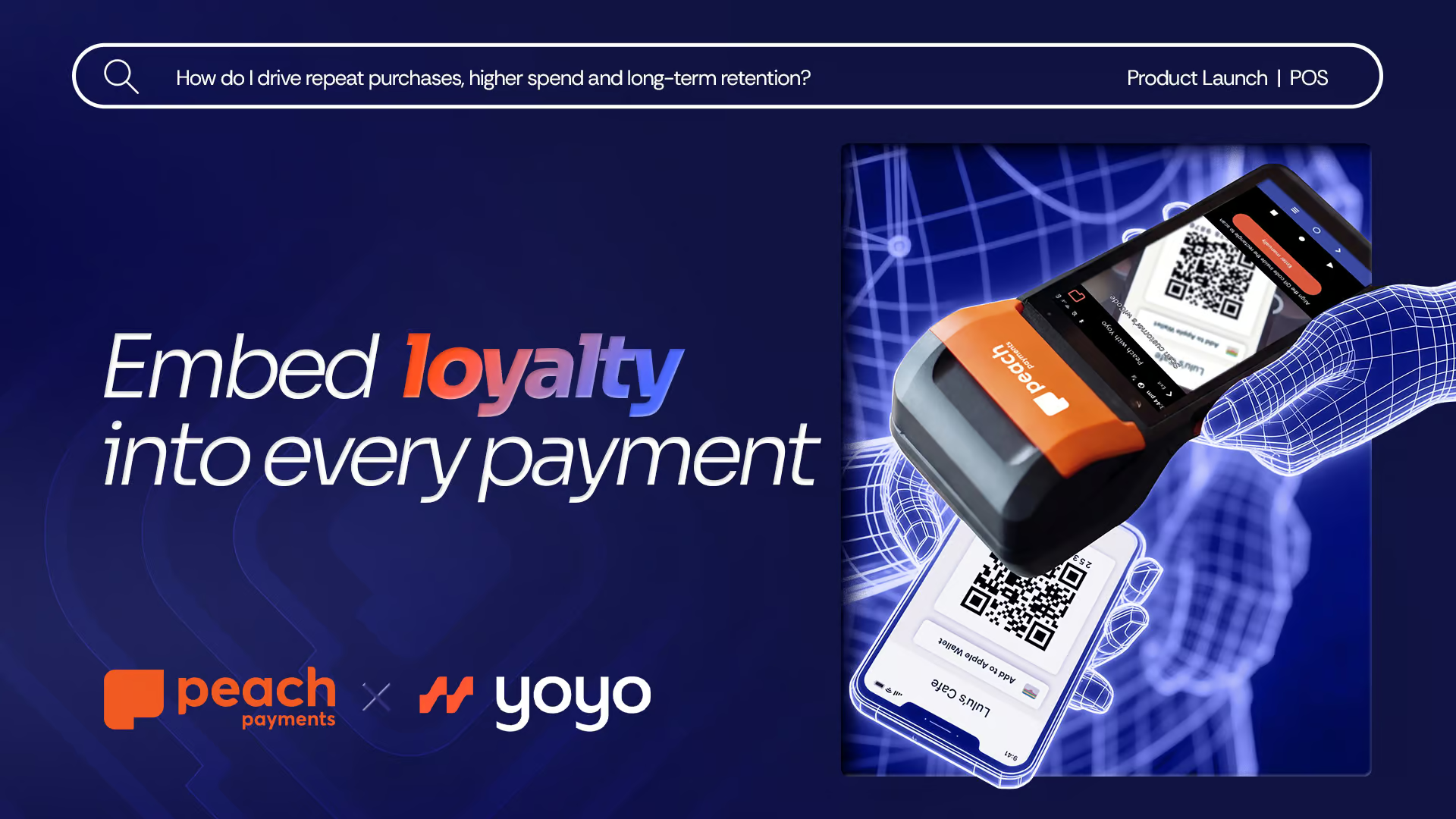
Peach Payments and Yoyo add bank card-linked loyalty to Digit Pro POS device
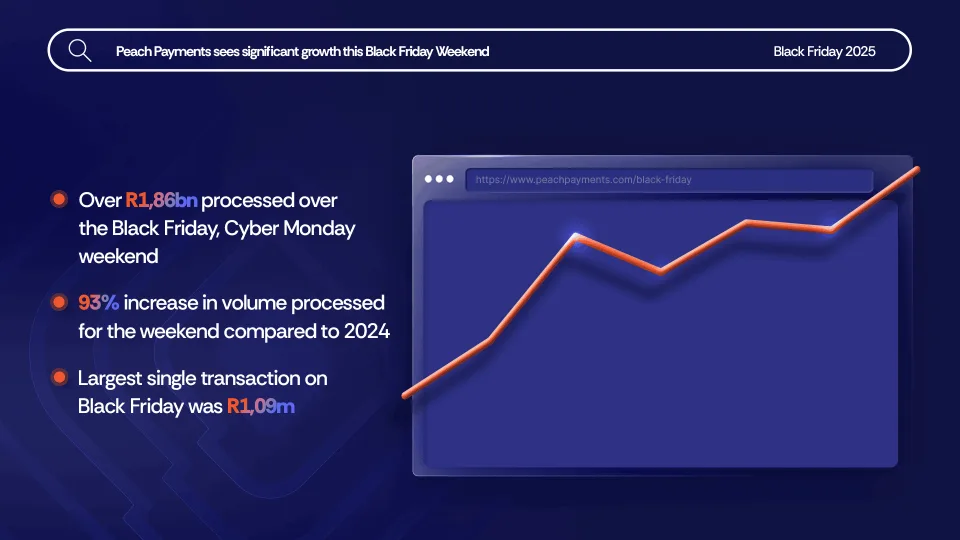
Black Friday up 93% over 2024, R1,86bn processed
Bringing Our New Peach Values to Life

Samsonite in-store payment methods
How global and regional companies can use the Mauritius IFC to centralise online payments and treasury functions
# PeachFriday Merchant Deals 2025
A merchant’s guide to chargebacks

Four Black Friday payment realities for merchants
What are Direct Merchant Accounts (ISO) versus Aggregation Accounts?
What Is 3RI? Everthing you need to know about Requestor-Initiated Authentication